
Introduction
In the physics world, Monte Carlo simulation has emerged as a game-changing technique, allowing researchers to tackle complex problems through probabilistic modeling. This article delves into the fundamentals of Monte Carlo simulation and explores its wide-ranging applications in the field of physics. Accompanied by recommended photos, we’ll uncover the power of this computational method and its ability to unlock valuable insights.
What is Monte Carlo Simulation?
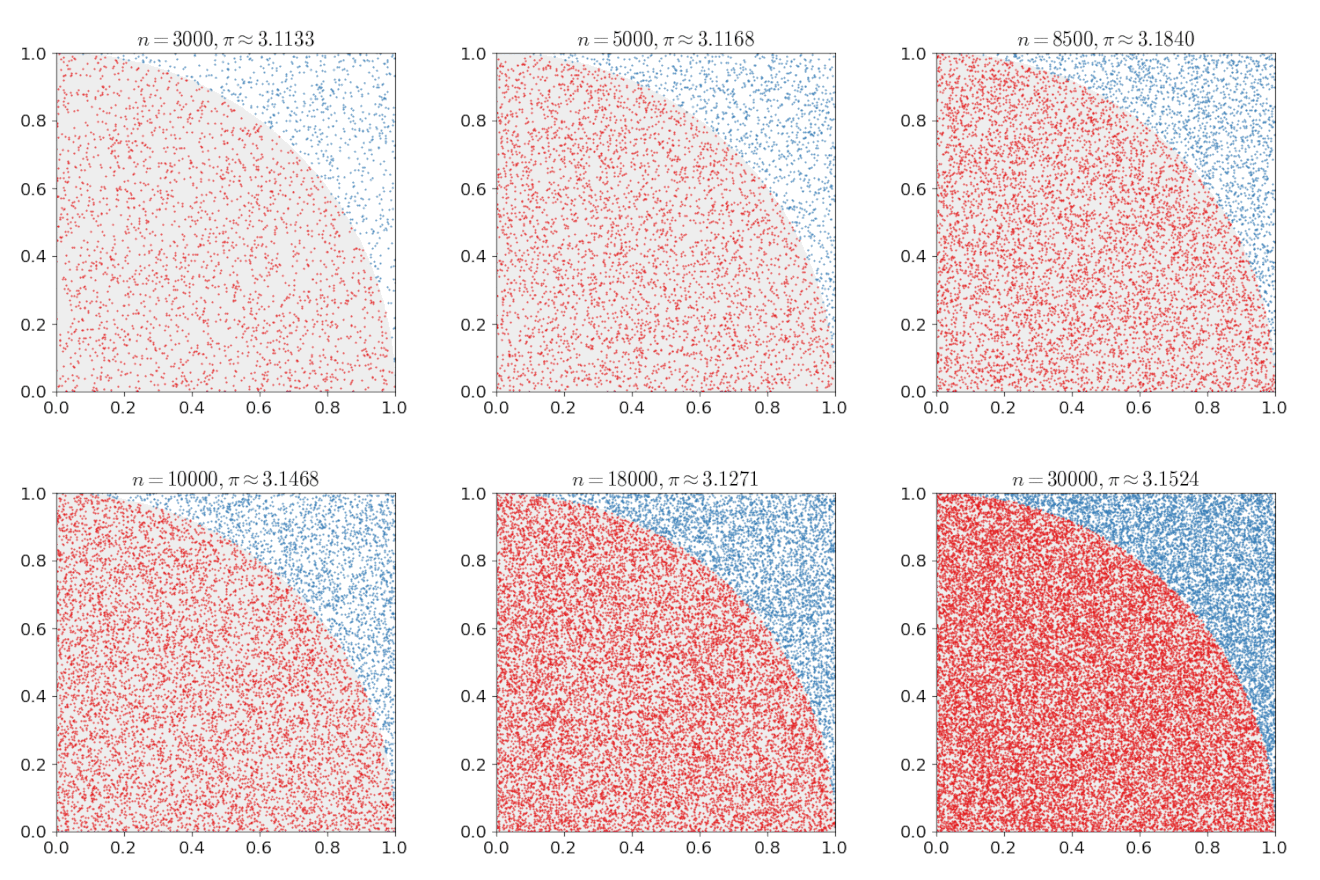
Monte Carlo simulation, named after the famous casino in Monaco, is a computational method that employs random sampling to simulate a wide range of possible outcomes for a given problem. It has found extensive use in physics due to its ability to model complex systems and phenomena accurately.
Applications in Particle Physics
Monte Carlo simulations are widely employed in particle physics experiments and collider facilities like the Large Hadron Collider (LHC). By simulating the collision of particles at high energies, researchers can predict the outcomes and understand fundamental particles’ properties and interactions.
Application in Statistical Physics
Monte Carlo simulations play a crucial role in statistical physics by providing insights into the behavior of complex systems and phase transitions. They allow researchers to study phenomena such as the Ising model, lattice gases, spin systems, and critical phenomena, providing valuable information about equilibrium states and thermodynamic properties.

Understanding Monte Carlo Simulation
At its core, Monte Carlo simulation involves generating random numbers within specified probability distributions and using them to estimate unknown quantities or simulate random processes. In the realm of physics, this technique allows researchers to investigate various phenomena, such as particle interactions, quantum systems, fluid dynamics, and statistical physics, by simulating their behavior through iterative random sampling.
Application in Quantum Systems
Quantum Monte Carlo simulations are utilized to study quantum systems that are difficult to solve analytically. These simulations help explore properties of atoms, molecules, quantum magnets, and condensed matter systems. They provide insights into energy levels, wave functions, and quantum phase transitions.
Application in Medical Physics
Monte Carlo simulation finds extensive application in medical physics, particularly in radiation therapy. It plays a crucial role in accurately predicting and optimizing radiation dose distributions, evaluating treatment plans, and estimating the effects of various parameters on treatment outcomes. By simulating the interaction of radiation particles with human tissues, Monte Carlo methods allow for precise modelling of radiation transport, enabling researchers and clinicians to assess the effectiveness of treatment techniques, optimize dose delivery, and ensure patient safety.
Conclusion
Monte Carlo simulation has become an invaluable tool in the field of physics, enabling researchers to tackle complex problems and gain valuable insights into various phenomena. From particle physics and statistical physics to quantum systems, this computational technique has revolutionized our understanding of the physical world. By harnessing the power of random sampling and probabilistic modeling, Monte Carlo simulation continues to push the boundaries of knowledge in physics.
Author: Abdelhai Ben Ali, PhD
Supporting documents
Here are supporting documents related to Monte Carlo Simulation in Physics:
- Praktiknjo, R., et al. (2019). Monte Carlo methods in modern physics. arXiv preprint arXiv:1902.07616 (2019), read the article.
- Newman, M. E. J., & Barkema, G. T. Monte Carlo Methods in Statistical Physics. Clarendon Press (1999), read the article.
- Landau, D. P., & Binder, K. A guide to Monte Carlo simulations in statistical physics. Cambridge University Press (2009), read the article.
 Computational Visua TEK